
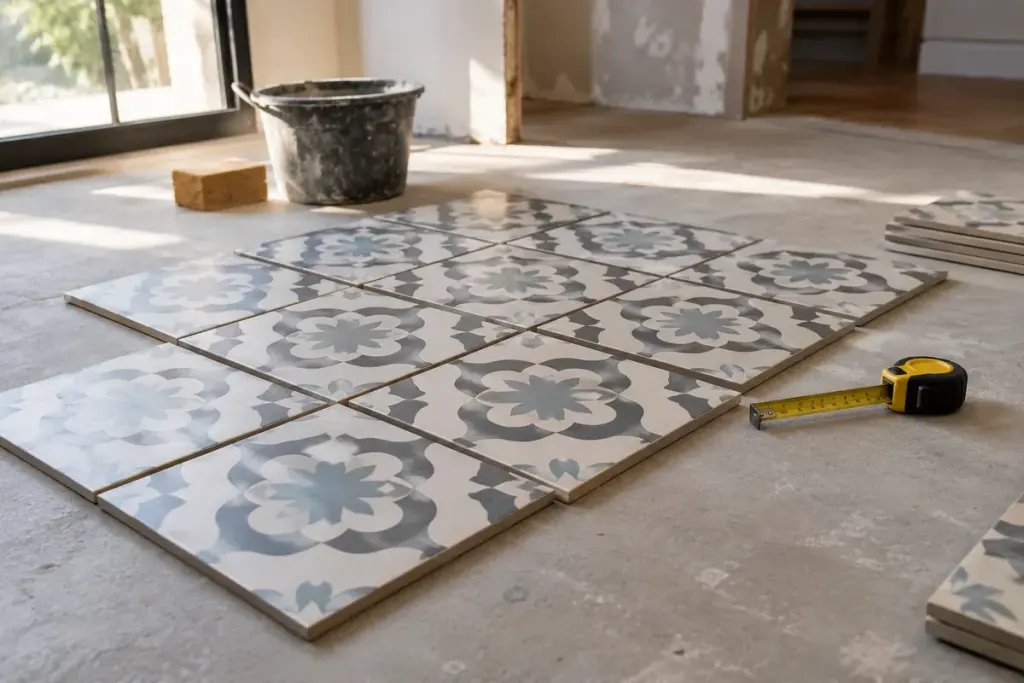
Four patterned tiles can form a beautiful motif on a showroom table. Across a real room, that motif may meet a doorway halfway through its shape and leave a thin strip along the most visible wall. The layout deserves its own decision before adhesive enters the job.
Lay out enough to reveal the edges
Daltile’s floor-tile installation guidance describes setting out loose tiles along reference lines with the intended joint spacing and adjusting the layout to avoid awkward small cuts. Treat that as a planning principle to discuss with your installer, not a substitute for assessing the substrate or installation system.
For a patterned design, check the direction and repeat as well as the size. Arrange several complete repeats where possible. Include the planned grout joints; laying tiles tightly together for the preview changes where the pattern will arrive at the wall.
View it from the entrance
Stand where you will normally first see the floor. Which line does your eye follow: the doorway, a kitchen island, a fireplace or the room’s longest wall? A mathematically centred layout is not automatically the most convincing arrangement when those features are off-centre.
Ask the installer to show the trade-off between two possible starting positions. One may give larger cuts at the side walls while the other makes a feature look more balanced. Photograph the alternatives and mark the agreed reference clearly before the loose pieces are lifted.
Check corners and thresholds, not only the easy central area. Rooms may be out of square. The plan should accommodate movement joints, transitions and technical requirements rather than shifting them purely to complete a decorative motif.
Approve a plan that can be reproduced
Keep a simple labelled sketch, product details and the approved photographs. Confirm who will decide if an unexpected condition changes the layout during work. Avoid relying on “start roughly here” when several people are involved.
Do not walk across an unstable dry layout or leave loose tiles where someone may trip. The preview is a controlled planning step. Its value is seeing the cuts and pattern relationships while they are still easy to change.