
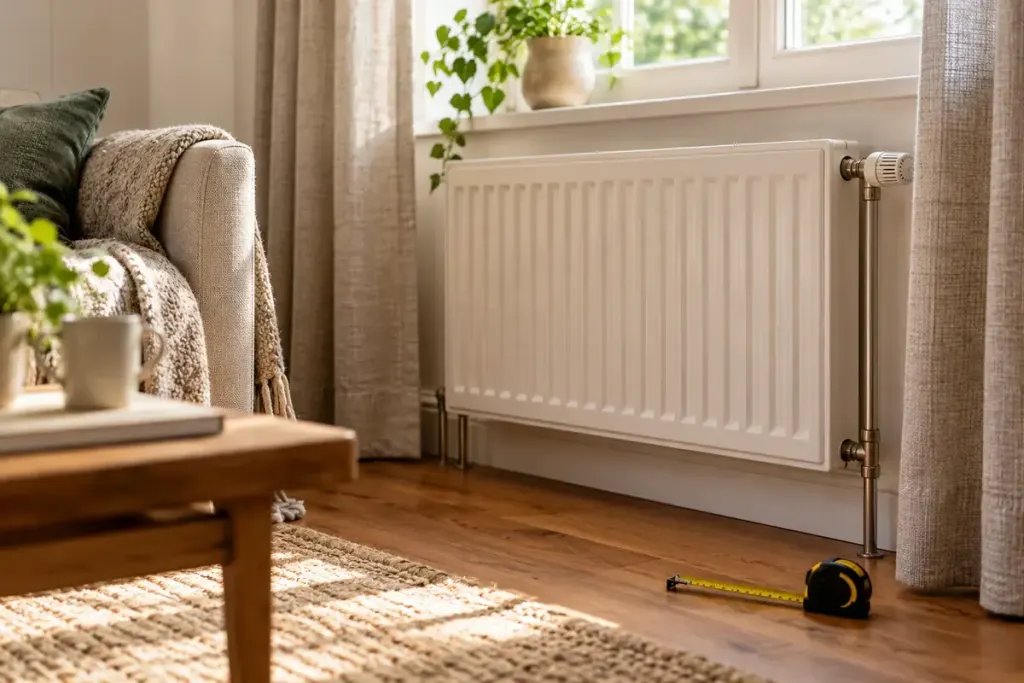
A radiator cover can make a room look more finished, but it also places new material around a heating appliance. Before ordering one, identify the radiator or heater and find the installation and clearance guidance that applies to it.
Do not copy a dimension from a photograph of another room. As radiator manufacturer Stelrad explains, a cover can affect heat output through its design and airflow. A cover suitable for one type of hot-water radiator is not automatically suitable for an electric heater or another appliance. Ask the manufacturer or a qualified installer when the instructions do not address the proposed arrangement.
Draw the whole corner of the room
Include the radiator, valves, nearby socket, curtain edge and furniture. Mark how a cabinet door opens and where the curtain hangs when closed. A cover that fits the wall can still create an awkward or unsafe relationship with the objects around it.
Keep access to controls and service points in the plan. Ask how the cover will be removed for inspection or maintenance, and whether that can be done without dismantling a built-in unit.
For a room-layout trial, draw the proposed cover to scale on a floor plan. Add the full opening arc of nearby doors and the area needed to reach the controls. This tests the occupied space without placing a temporary enclosure around a heating appliance.
Ask about heat and airflow before choosing the finish
The installer should explain whether the proposed cover affects the appliance’s operation, temperature sensing or performance. Vent openings should follow an appropriate design, not a decorative pattern chosen without regard to the equipment.
- Confirm the exact appliance type and model.
- Obtain the relevant clearance and material requirements.
- Check access to valves and maintenance points.
- Review nearby curtains, furniture and items likely to be stored on top.
Do not turn the finished cover into a drying rack unless the appliance manufacturer explicitly permits the arrangement. A convenient horizontal surface can invite uses that were never considered during installation.
Keep the approved drawing or product instructions with the room’s renovation records. If the radiator is replaced later, revisit the cover rather than assuming the old enclosure remains suitable. A good-looking finish should be the result of a workable heating layout, not a substitute for one.