
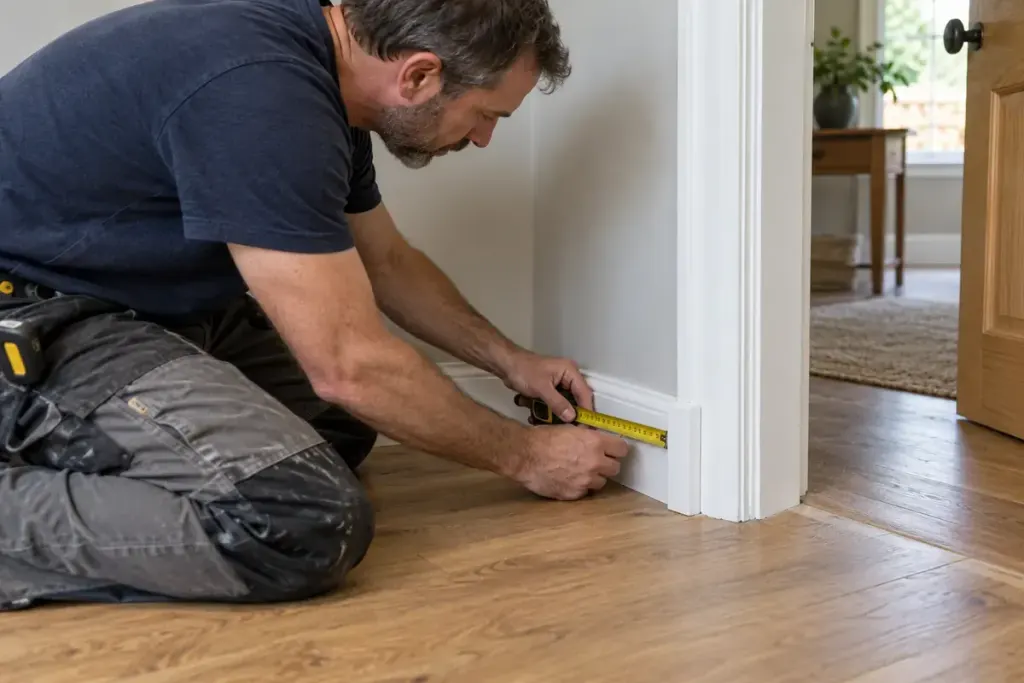
A skirting board can run neatly along a wall and still end with an awkward exposed profile beside a doorway. A return is a small finishing arrangement that brings the profile back toward the wall rather than leaving the cut end visible.
Before choosing it, check the trim material, profile and the detail intended by the maker or installer. Not every board or location needs the same solution. A square end, end cap or different junction may be more suitable.
Draw the end before measuring the length
Sketch the wall, doorway and finished face of the trim from above. Mark where the exposed end will sit and how the return will meet it. This separates the visible finishing point from the length of the main straight piece.
Check nearby door movement, architrave and changes in floor level. A tiny return that looks elegant in isolation may leave a vulnerable projection where shoes or cleaning equipment repeatedly strike it.
Use offcuts to confirm the joint geometry and the profile alignment. Small pieces can be difficult to handle safely with power tools. Follow the tool manufacturer’s work-holding requirements, and ask a competent installer to make the cut if the piece cannot be supported safely. Never hold a tiny offcut close to a moving blade.
Dry-fit the whole junction
Put the main board and return in place without committing to adhesive or final fixing. Check the joint from ordinary viewing positions and verify that the return reaches the wall as intended. Allow for the actual wall surface rather than assuming it is perfectly square.
Plan the appropriate preparation, fixing and finish for the material. Filler should not be expected to rescue a joint whose shape was never tested.
A few minutes spent on the end detail prevents the familiar problem of cutting the main board to the wrong reference point. The smallest piece often needs the clearest drawing.