
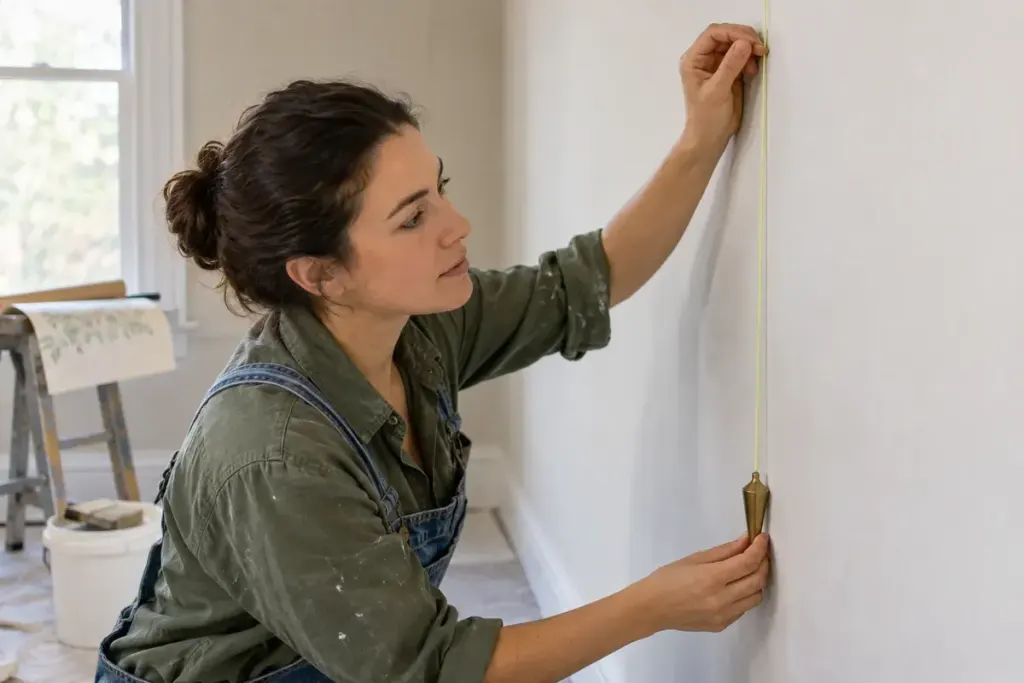
The first wallpaper strip can look neat against a corner while leaving every later strip slightly tilted. Corners and door frames are not guaranteed to be vertical. A plumb reference gives the paper its own starting line.
Graham & Brown’s hanging guide uses a plumb line to establish the first drop. Follow the instructions for the paper you bought, including whether paste goes on the wall or paper. Starting position and overlap depend on the roll width, pattern, and room.
Check the reference before adding paste
Use an appropriate level or plumb tool to mark a light vertical guide in the planned starting position. Compare that guide with the corner. If they diverge, the discrepancy is useful information: forcing the entire strip to follow the corner would carry the error across the wall.
Try a dry layout with the roll width and pattern repeat in mind. Note where seams would meet windows, doors, and the final corner. A few pencil measurements can reveal an awkward narrow strip before adhesive makes changes harder.
Keep the manufacturer’s pattern-matching instructions with your cut lengths. Mark the sequence discreetly so a carefully planned first drop is not followed by a strip prepared for another position. Check alignment as you proceed rather than waiting until several drops are in place.
A useful project note includes the starting reference, roll batch details, and pattern repeat. If work continues the next day, that record is more reliable than trying to remember which architectural edge you trusted.
For uneven walls, difficult corners, or work near electrical fittings, obtain suitable professional help. The plumb line solves a positioning problem; it does not repair the wall or make electrical work safe. Begin with a sound surface and a verified reference, then let the paper follow the plan.