
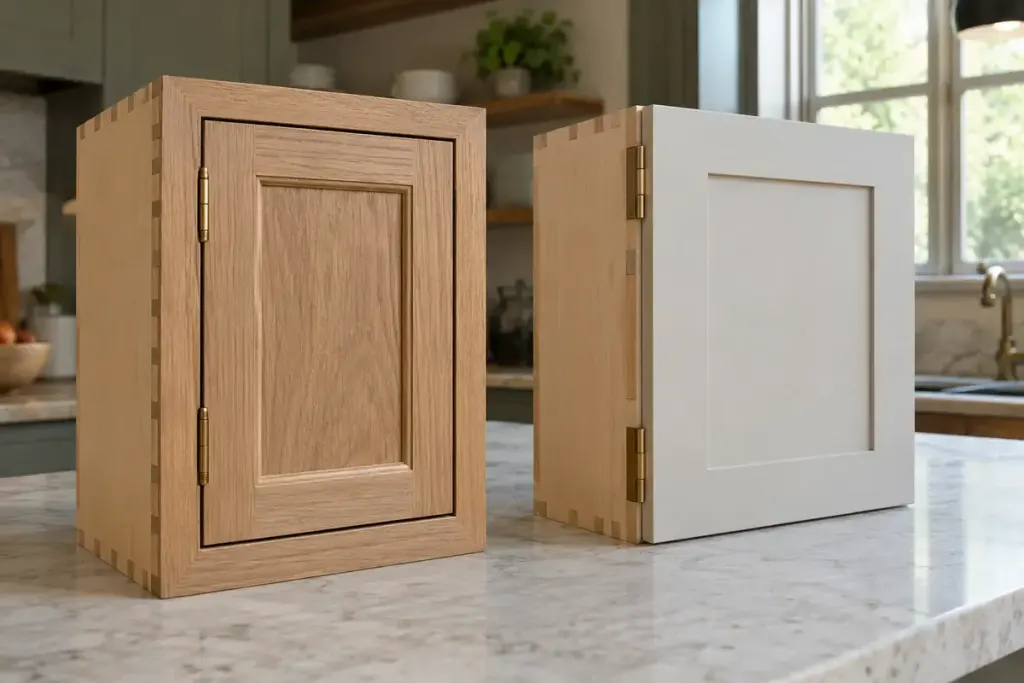
A replacement cabinet hinge can look almost identical to the old one and still put the door in the wrong place. One reason is the relationship between the door and the cabinet opening: does the door sit inside it, or cover part of its front edge?
Look at the closed door first
An inset door sits within the opening, with a clearance around its edges. An overlay door covers some of the cabinet’s front. Those arrangements change how the hinge must carry the door as it opens and closes. The Blum hinge catalogue distinguishes application types and shows why hinge and mounting-plate choices belong together.
Take a photograph with the door closed, another with it open and a close view of any identification marks. This gives a supplier more useful information than a picture of the metal cup alone.
Record the geometry before buying
Note the door thickness, the amount of overlay or inset clearance, the cabinet construction and the existing fixing positions. A framed cabinet and a frameless cabinet may need different hardware arrangements. Nearby drawers, walls and handles can also limit the useful opening angle.
For an illustrative repair, suppose a door rubs against an adjacent drawer after a hinge replacement. Do not immediately trim the wood. First check whether the replacement is intended for the original application and whether its plate and adjustment range match. Removing material can make a hardware mismatch harder to reverse.
Trial one door before ordering a full set
Ask the supplier to confirm the combination against the manufacturer’s drawing. Fit and adjust a sample according to its instructions, then check the gap, closing action and clearance through the full swing.
When several doors share an edge, inspect them together rather than judging each one in isolation. A successful replacement preserves a consistent reveal and a comfortable opening movement; matching the finish of the hinge is only one part of that result.