
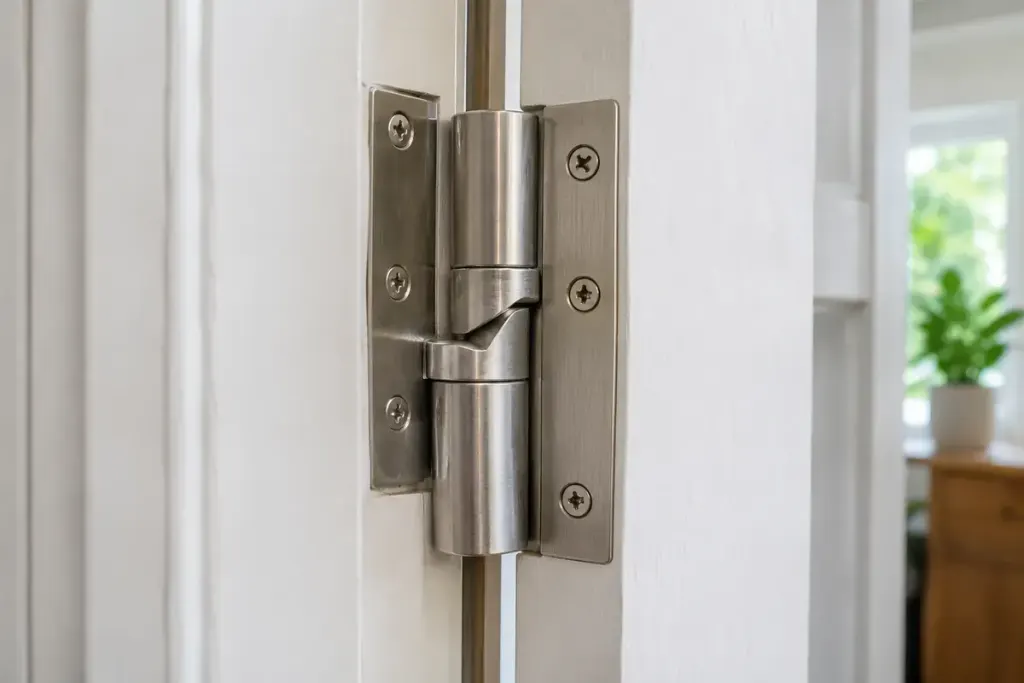
A door that catches the floor can make a rising butt hinge sound like an instant solution. This hinge does lift the door as it opens, but it changes more than the gap beneath the bottom edge. Its suitability depends on the whole door arrangement.
A rising butt hinge uses shaped bearing surfaces or cams so rotation also produces vertical movement. An archived Häfele specification illustrates rising and falling versions, handing, weight limits, and closing behaviour. It is a useful explanation of the mechanism, not a current specification for every product sold under the name.
Find out why the door is rubbing
First describe where contact occurs. Is the door catching one high point in the floor, scraping across a new carpet, or dropping because existing hinges or fixings need attention? Those are different problems. A hardware change should not conceal a loose fixing, a distorted frame, or another fault that needs repair.
When discussing the job with a fitter, include the door’s material, weight, thickness, opening direction, and the flooring change that prompted the question. Photographs of the contact point can help, but measurements and an inspection determine what will actually fit.
Leave room for the upward movement
If the door rises, the clearance above it must accommodate that rise. The handle and lock alignment also need to work in the closed position. Check the proposed hinge’s exact lift, opening range, handing, and installation requirements rather than borrowing dimensions from another model.
Closing behaviour deserves attention too. Some rising arrangements encourage the door to return under its own weight, and a suitable damper may be part of the design. Consider the people using the doorway and the risk of unexpected movement.
Do not assume an ordinary hinge substitution is acceptable on a fire door or other regulated doorset. Have the required hardware and performance checked by a competent person.
A good proposal explains both the original rubbing problem and the consequences of the new hinge. The mechanism can be useful, but the decision belongs to the door, frame, floor, and user together.