
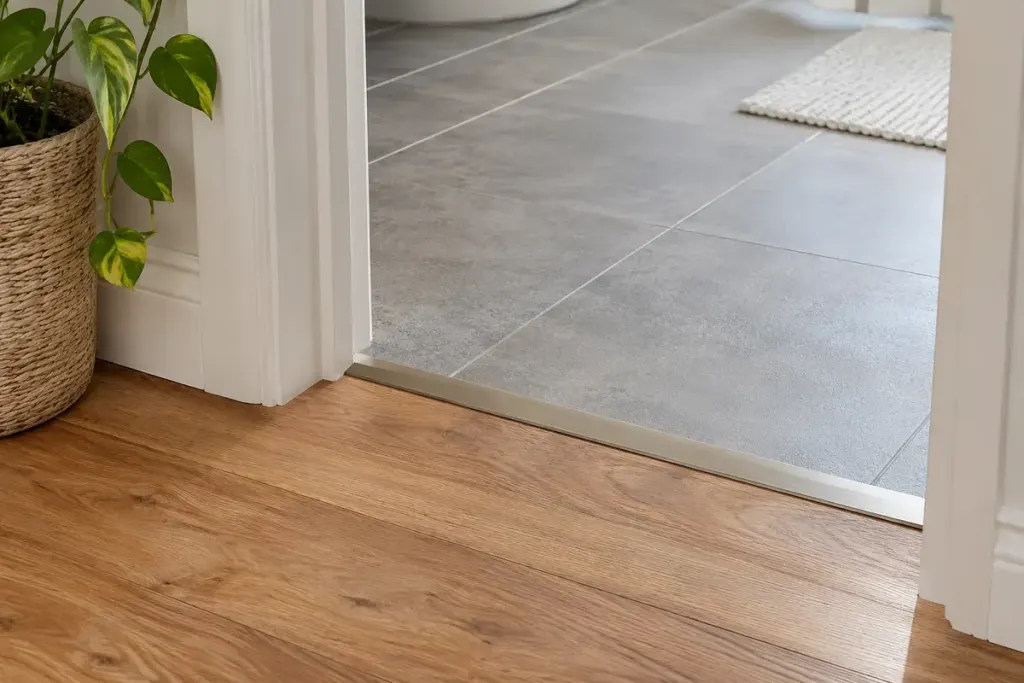
The flooring samples look good together on the table. At the doorway, however, one finished surface may sit higher than the other. The join also has to accommodate the way each flooring system is installed and moves.
A transition is therefore more than a narrow strip chosen at the end of the project. Plan it while the floor build-ups and door clearances can still be checked.
Compare finished levels, not bare boards
Ask the installer to account for the complete build-up on both sides: the floor covering, adhesive or underlay and any preparation beneath it. Two materials of similar thickness do not necessarily finish at the same height.
Use a small section sketch to show the proposed join. It should make clear where the materials end, what supports the transition and how any height difference is handled. Product instructions and the actual site conditions should lead the detail.
Keep movement requirements in the discussion
Some flooring systems require space to move. A neat-looking join that clamps a floating floor or fills a required gap can create a problem even when it looks excellent on installation day. Ask how the proposed profile respects each manufacturer’s requirements.
Do not assume that a bead of sealant is a substitute for a designed transition. Its suitability depends on the materials, location and intended movement.
Check the door and the route through it
- Does the door clear the finished floor and profile throughout its swing?
- Where does the join sit when the door is closed?
- Is the change easy to see and comfortable to cross?
- Will wheeled furniture or mobility equipment use this route?
- Can the edge be cleaned without catching or loosening it?
For example, a profile hidden neatly below a closed door may still be awkward if it creates an unnecessary ridge in a frequently used route. Look at the practical movement through the opening, not only the photograph from above.
Bring the two flooring samples and the proposed profile together under the room’s light, then approve the appearance after the technical detail is resolved. That order helps you choose a join that looks intentional because it works, rather than a decorative cover for a problem discovered too late.