
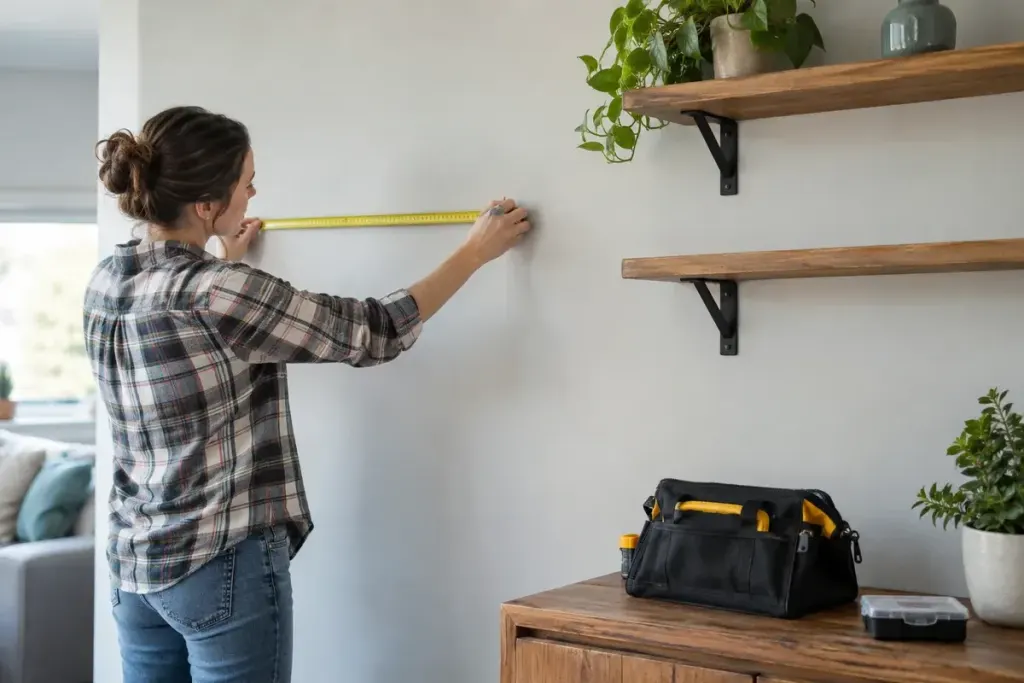
A shelf can look beautifully proportioned in a room sketch and still be the wrong installation for the wall behind it. Books, ceramic bowls and framed prints ask different things of the same narrow board.
Before buying hardware, describe what the shelf will hold and identify the wall construction. Decorative planning and structural suitability need to meet before the drill comes out.
Define the load honestly
List the items you expect to store, including the shelf itself where relevant to the manufacturer’s instructions. Think about the likely future use too. A display shelf often becomes a convenient place for heavier objects unless its purpose is clear.
Do not treat the rating on one bracket or fixing as the rating of the complete installation. The shelf, brackets, fasteners, spacing, wall condition and installation method work as a system. Follow the product’s stated conditions rather than adding individual ratings together.
Identify what you are fixing into
Paint colour tells you nothing about the material beneath it. Masonry, hollow construction and framed walls can require different hardware and installation methods. IKEA’s wall-attachment guidance makes the basic point that suitable screws depend on wall material; the instructions for your actual shelf remain the starting point.
If you cannot establish the construction, condition or presence of concealed services, ask a qualified installer to assess it. Do not drill into an uncertain area simply because a detector gave no warning. Product manuals and local building conditions matter.
Draw the room around the installation
Use a paper outline to assess height and width without committing to holes. Check door swings, seating, everyday reach and the route people take past the shelf. A layout that works in a photograph may create an awkward projecting corner beside a frequently used doorway.
For a rental, check the permission and reinstatement requirements before installation. Adhesive alternatives should only be used within their explicit product limits; they are not a universal substitute for a mechanically fixed shelf.
Keep the useful information afterwards
Retain the model, installation instructions and any stated load conditions. Make the intended use clear to others in the household. If the shelf becomes loose, tilts or shows damage, unload it safely and have the cause assessed rather than tightening a visible screw and assuming the whole system is sound.
The best-looking shelf is one that suits the room and its real use. Spending time on the wall and load first leaves the enjoyable choices—finish, spacing and display—on a more dependable foundation.