
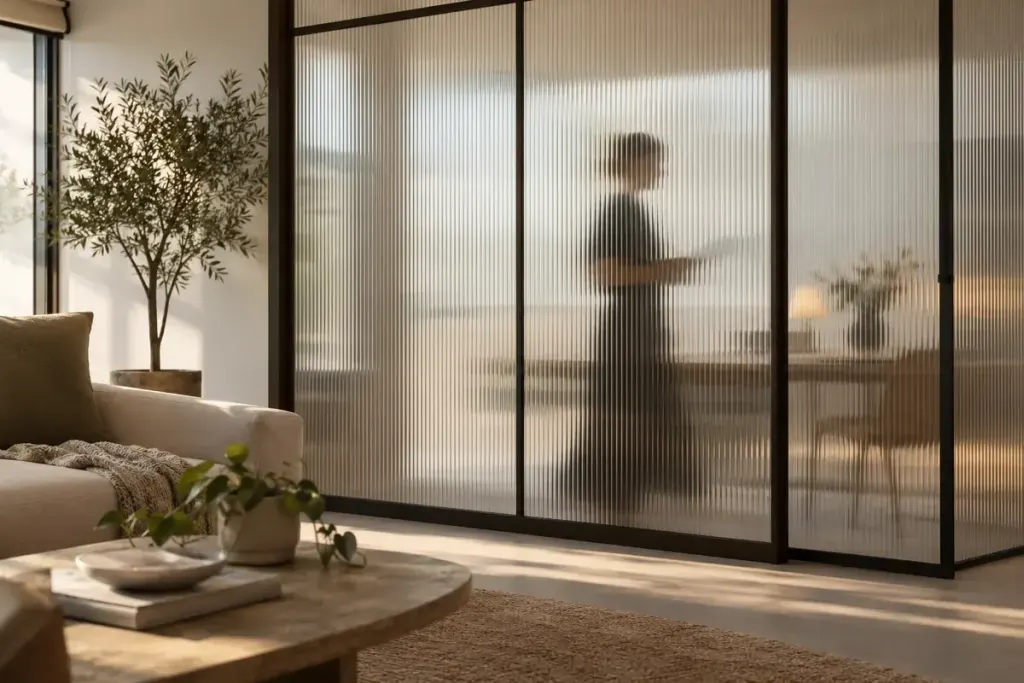
A fluted-glass sample looks beautifully obscure on a showroom counter. Installed beside a brightly lit room, it may reveal more movement and shape than expected. A small decorative sample is a starting point, not a complete privacy test.
Textured glass comes in different levels of obscuration. Pilkington’s texture-glass range, for example, distinguishes five privacy levels and says the final glass specification must suit the location and safety requirements. That rating belongs to the specified product; it should not be assumed for every pane described as reeded or fluted.
Recreate the view that matters
Ask the supplier to demonstrate the actual pattern and thickness you are considering. With permission, have someone stand at the likely distance behind the sample while another person observes from the public side. Repeat with the positions nearer and farther away.
Include the lighting conditions that are easy to overlook: an illuminated bathroom at night, a dark corridor looking into a bright office, or a lamp near the partition. Decide whether your requirement is to blur detail, conceal silhouettes or block the view entirely.
Write a practical privacy brief
For an illustrative example, a study partition might only need to soften the sight of shelves. A changing area has a different expectation. Describe the required result to the glazier instead of choosing solely by a product photograph.
Consider whether a blind or another screen is needed when complete concealment matters. Ask how that addition will be operated and cleaned without obstructing the door or walkway.
Leave the construction specification to the installer
Appearance does not establish impact safety, fixing suitability or compliance for a particular location. Confirm those requirements with a qualified glazier. Keep the approved sample reference with the order so the installed pattern, orientation and glass construction can be checked against the agreed specification.