
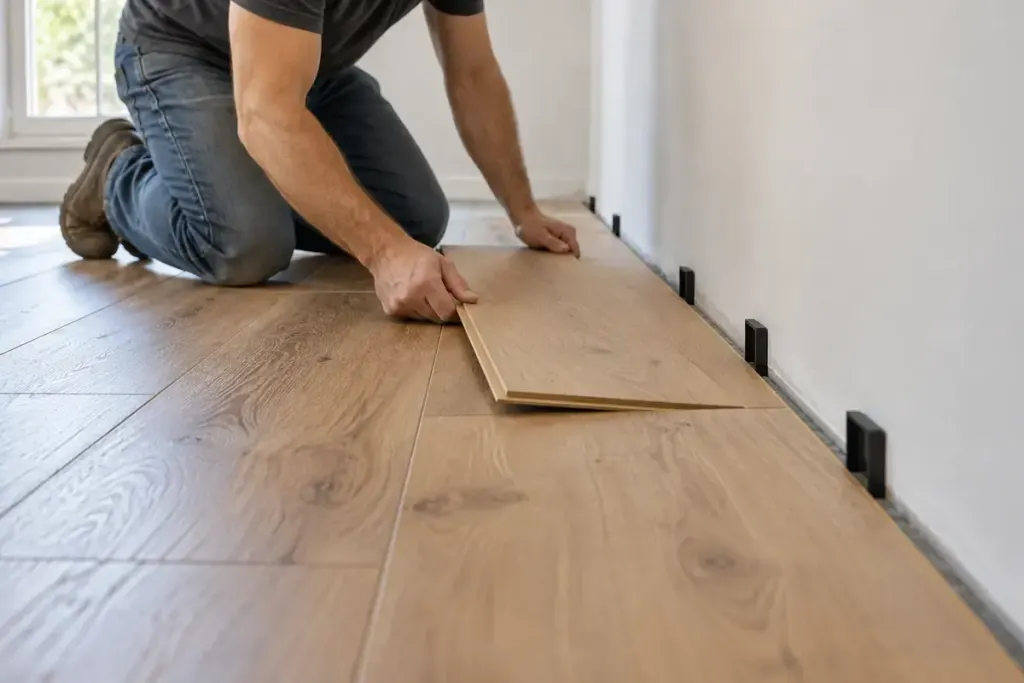
The last strip of flooring reaches the wall, leaving a gap that looks unfinished. With a floating floor, that space can be an intentional part of the installation. Covering the edge neatly should not mean preventing the floor from moving as designed.
Use the instructions for the actual product
Different flooring systems have different requirements for perimeter gaps, room size, transitions and environmental conditions. Quick-Step’s laminate installation guidance, for example, directs installers to allow an expansion gap and use the product’s installation instructions. Do not copy one dimension from a photograph and apply it to every floor.
Confirm the product, installation method and room conditions with the installer before work begins. A floating installation is not the same as a floor bonded to the subfloor. Subfloor preparation and moisture requirements also need to be addressed; a perimeter gap cannot compensate for an unsuitable base.
Look around obstacles, not just walls
Door frames, pipes, columns and transitions to another room may need specific details. Ask how those points will accommodate movement and remain visually tidy. Photograph the completed edge details before skirting or trim conceals them, with the installer’s agreement.
Discuss heavy fixed furniture and fitted units using the manufacturer’s instructions. Do not assume that every object can be placed over a floating floor without affecting how the system behaves.
When finishing the room, avoid filling a required movement space with an unsuitable rigid material merely because the gap is visible. Ask which trim or approved detail belongs there and what it should be fixed to. The finish should follow the floor’s design rather than trapping it.
Keep the installation guide and product identification with your renovation records. If a later repair is needed, those details help distinguish an appearance issue from a system installed outside its requirements. The best moment to resolve an edge question is while the edge can still be seen.